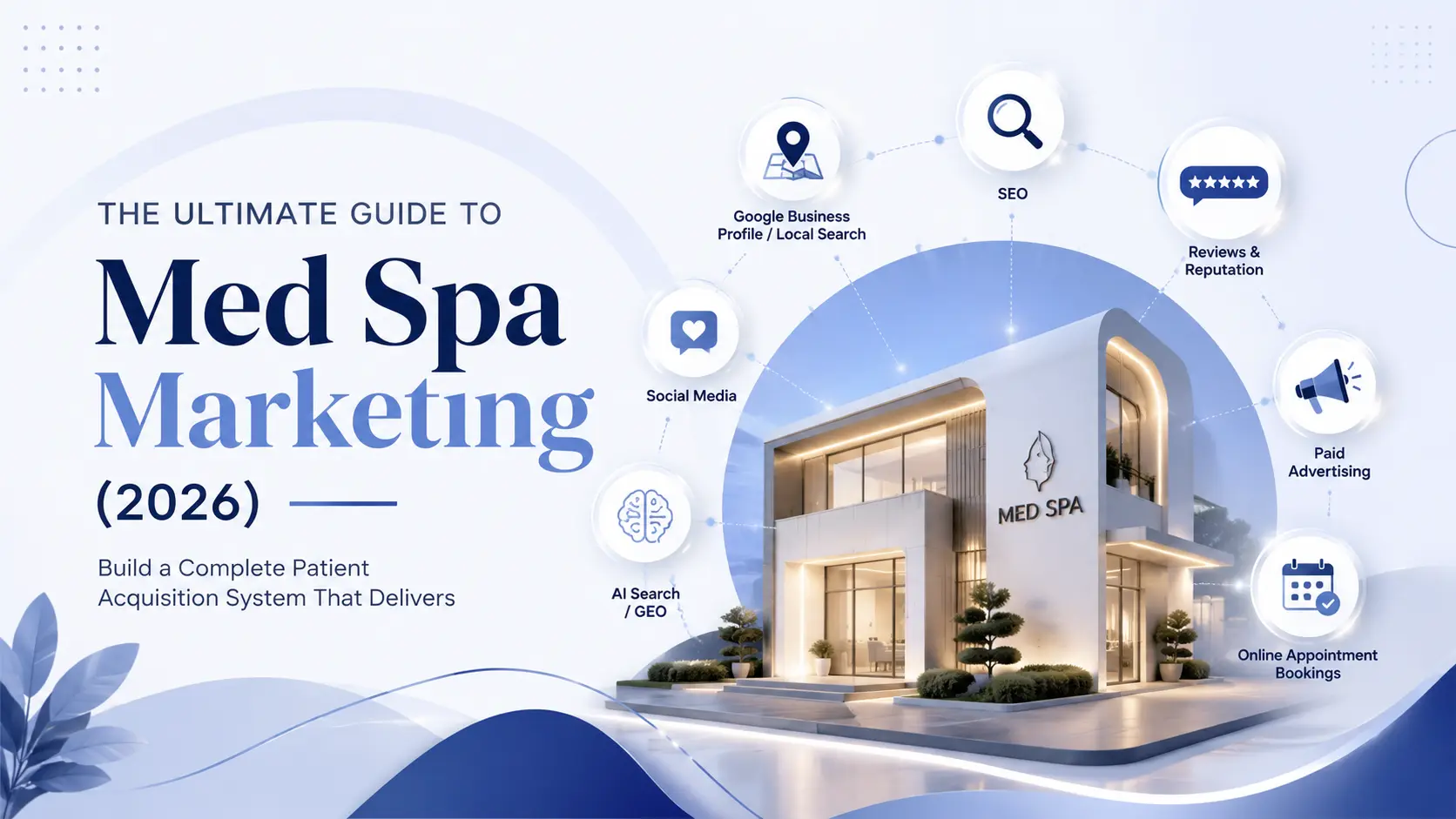
Med spa marketing is how an aesthetic practice attracts and books new patients by combining a strong Google Business Profile, local SEO, reviews, email and SMS, paid ads, and increasingly AI-search visibility into one system. The practices that win in 2026 treat these channels as a connected engine — and treat advertising compliance as part of the strategy, not an afterthought.
Boost Web DigitalContributor
··9 min read
Why Med Spa Marketing Is Harder — and More Winnable — Than Ever
There were about 10,488 medical spas in the U.S. in 2023, up from 8,899 the year before, according to the American Med Spa Association (AmSpa).
At the same time, the average single-location med spa grew revenue to $1,398,833 in 2024 — a 6.98% year-over-year increase.
The takeaway is important: demand is rising faster than supply, so the market hasn’t hit saturation.
The practices that struggle aren’t losing because the market is tapped out. They’re losing because they’re harder to find and harder to trust online than the spa down the street.
That’s the whole game.
A patient searching “Botox near me” or “best med spa in [your city]” makes a decision in seconds, based on who shows up, who has the reviews, and who looks trustworthy.
Marketing is simply the work of being the practice they choose.
This guide is built for the owner or practice manager who is time-poor and tired of agencies that talk in “impressions” instead of booked consultations.
It covers the full system — foundation, channels, funnel, AI search, and the compliance layer most guides skip.
If you only take one thing from this guide, take this: you don’t need to do everything. You need to do the highest-leverage things in the right order.
What Med Spa Marketing Actually Includes
Most guides hand you a list of 20 strategies and let you drown.
Here’s the map that actually matters, grouped by what job each part does.
Layer
What It Does
Channels
Time to Results
Foundation
Makes you findable and trustworthy
Google Business Profile, reviews, website
Weeks to a few months
Owned Audience
Rebooks people who already know you
Email, SMS, loyalty
Immediate, compounding
Organic Reach
Earns new patients without paying per click
Local SEO, content/blog, social
3–6 months
Paid Reach
Buys visibility fast
Google Ads, Meta/Instagram ads
Days
AI Visibility
Gets you recommended by AI search
GEO / answer-engine optimization
Weeks to months
Compliance
Keeps every channel legal and safe
FDA / FTC / state board rules, HIPAA consent
Ongoing
The mistake owners make is starting with the exciting parts — paid ads and viral reels — before the foundation is solid.
Build left to right.
Step 1: Fix Your Foundation Before You Spend Money on Ads
Your Google Business Profile Is Your Most Valuable Asset — and It’s Free
For a location-based business, your Google Business Profile helps determine whether you appear in the local 3-pack — the three map results shown above regular organic results for many local searches.
Getting the fundamentals right is unglamorous and high-impact:
Choose the most accurate primary category, usually “Medical spa.”
Add relevant secondary categories.
List every treatment as a service with a real description.
Add high-quality photos of your space and team.
Use properly consented results imagery where applicable.
Post regularly.
Keep your name, address, and phone number identical everywhere online.
Reviews Are the Second Free Lever — and They Do Double Duty
Reviews influence both patient decisions and local visibility.
A wall of recent reviews creates more trust than a handful of stale ones. Review volume, freshness, and sentiment can also influence local search visibility.
Because med spas are healthcare providers, however, review requests need to be handled carefully with patient privacy and applicable rules in mind.
Your Website Is the Destination Everything Points To
Every channel ultimately sends people to your website.
If it loads slowly, hides your process, or buries the booking button, you’re leaking patients your marketing worked to attract.
Your Website Should Have:
Mobile-first, fast performance
Dedicated pages for every treatment
A clear booking path
Online scheduling where appropriate
Real photography
Named practitioners and credentials
Strong trust signals
Step 2: Turn On Your Owned Audience
Email marketing and SMS allow med spas to communicate with people who already know the practice.
For a med spa, owned-audience marketing does three jobs:
1. Rebooking
Aesthetic treatments are recurring by nature.
Botox, facials, and similar services can create natural opportunities for reminder and recall campaigns.
2. Reactivation
Reconnect with patients who haven’t visited in 6–12 months using targeted and respectful messaging.
3. Launches and Events
New treatment, promotion, or open house?
Your existing audience can become the first source of attendance.
SMS can also work well for reminders and time-sensitive offers, but consent requirements must be handled appropriately.
Step 3: Build Organic Reach So You Stop Renting Every Patient
Paid advertising provides visibility while you’re paying for it.
Organic marketing takes longer but can compound over time.
Local SEO and Content
Local SEO helps your practice compete for location-based searches.
Content SEO helps you answer questions patients ask before they’re ready to book:
How long does Botox last?
Botox vs. Dysport
Is CoolSculpting worth it?
What should I expect from a treatment?
Answering these questions well can build both search visibility and patient trust.
SEO and organic social typically take three to six months to show consistent results.
Social Media — Where Med Spa Marketing Actually Shines
Aesthetics is a visual, trust-driven category, making social media particularly useful for med spas.
Content opportunities include:
Before-and-after transformations with proper written consent
Educational treatment content
Practitioner-led videos
Treatment explanations
Patient education
Don’t focus only on followers and likes.
Track the metrics that matter:
Consultations → Bookings → Revenue
Step 4: Use Paid Ads to Buy Speed — Deliberately
Paid advertising’s biggest advantage is speed.
Google Ads can potentially generate bookings within days, while SEO may take months.
That makes paid advertising useful for:
New-location launches
Slow seasons
Time-limited events
Specific treatment campaigns
Two Rules for Paid Advertising
1. Never send paid traffic to a weak page.
A high-cost click that lands on a slow or unconvincing page is wasted budget.
2. Watch cost per consultation, not just cost per click.
A higher CPC that produces more booked consultations can be more valuable than a cheap click that produces nothing.
Step 5: Get Recommended by AI Search
Patients increasingly ask ChatGPT, Gemini, or Google’s AI Overviews questions such as:
“What’s the best med spa for Botox near me?”
AI systems can return a short list of recommended practices.
If your practice isn’t included, you’re invisible to that patient.
The practices treating GEO as a real channel now are positioning themselves for the AI-first search journey.
Step 6: The Compliance Layer Most Marketing Guides Ignore
Aesthetic marketing sits at the intersection of multiple regulatory frameworks, including:
FDA
FTC
State medical boards
HIPAA requirements where applicable
A marketing claim can satisfy one standard while still creating issues under another.
Four Compliance Rules That Matter Most
1. Substantiate Every Claim
Avoid unsupported claims such as:
“Dramatic results”
“Lose 20 pounds”
“Permanent results”
Guaranteed outcomes
Clinical claims should have appropriate supporting evidence.
2. Get Proper Consent for Before-and-After Photos
Before-and-after imagery involving patients requires appropriate authorization for advertising use.
General treatment consent should not automatically be treated as advertising authorization.
3. Identify the Supervising Physician Where Required
State rules can vary significantly.
Review the applicable requirements for your location before publishing.
4. Watch Off-Label and Compounded-Product Claims
These areas can create additional regulatory risk and require careful review.
When in doubt, have healthcare counsel or an appropriate compliance professional review the marketing material.
How Much Should a Med Spa Spend on Marketing?
A common industry benchmark is 10–20% of annual revenue allocated across marketing activities such as:
Website
SEO
Paid advertising
Social media
Email/SMS
Events
However, a percentage should only be a starting point.
The better question is:
What is your cost per booked consultation, and which channel delivers it most efficiently?
Track that number and use the evidence to guide your budget.
Your 90-Day Med Spa Marketing Starting Sequence
Days 1–30: Foundation
Fully optimize your Google Business Profile
Improve website speed
Fix the booking flow
Build dedicated treatment pages
Establish a compliant review-request process
Days 31–60: Owned + Organic
Launch email/SMS recall campaigns
Begin patient reactivation
Publish treatment-focused content
Start local SEO
Build your organic content foundation
Days 61–90: Amplify
Launch targeted paid advertising
Publish educational social content
Use properly consented before-and-after content
Strengthen AI-search visibility
Add answer-first content structures
Compliance should run across all 90 days — not be treated as a final checkbox.
Frequently Asked Questions
How Much Does Med Spa Marketing Cost?
Most practices use a starting benchmark of 10–20% of annual revenue across their marketing channels. However, cost per booked consultation is a more useful performance metric.
How Long Does Med Spa Marketing Take to Work?
Paid advertising can generate bookings within days. SEO, content, and organic social typically require three to six months to show consistent results. Email and SMS can generate revenue more quickly from an existing audience.
What’s the Single Most Important Med Spa Marketing Channel?
For a location-based practice, Google Business Profile and reviews are high-leverage starting points because they influence both local visibility and patient trust.
Do I Still Need SEO If I’m Running Google Ads?
Yes.
Paid advertising stops when you stop paying. SEO can compound over time and create a more durable source of organic visibility.
Is It Legal to Post Before-and-After Photos of My Patients?
Before-and-after patient imagery used for advertising requires appropriate, specific authorization. General treatment consent should not automatically be considered permission for marketing use.
How Do I Get My Med Spa Recommended by ChatGPT and AI Search?
Focus on GEO through answer-first content, consistent business and practitioner information, structured data, and a strong, verifiable review footprint.
The Bottom Line
Med spa marketing in 2026 isn’t about chasing every new tactic.
It’s about building a connected system:
Foundation → Owned Audience → Organic Reach → Paid Speed → AI Visibility
With compliance woven through all of it.
The practices that win aren’t necessarily doing the most.
They’re doing the right things in the right order — and becoming the practice patients can find and trust.
Ready to Build Your Med Spa Growth System?
If you’d like a specialist to map that system for your practice, book a free med spa growth plan.
We’ll audit where you stand across Google and AI search and show you the fastest path to more booked consultations.
Written by
Boost Web Digital
Contributor
Find out what AI says about your practice
We run fifteen patient questions across four AI engines, count how many times your practice gets named, and send you the report.