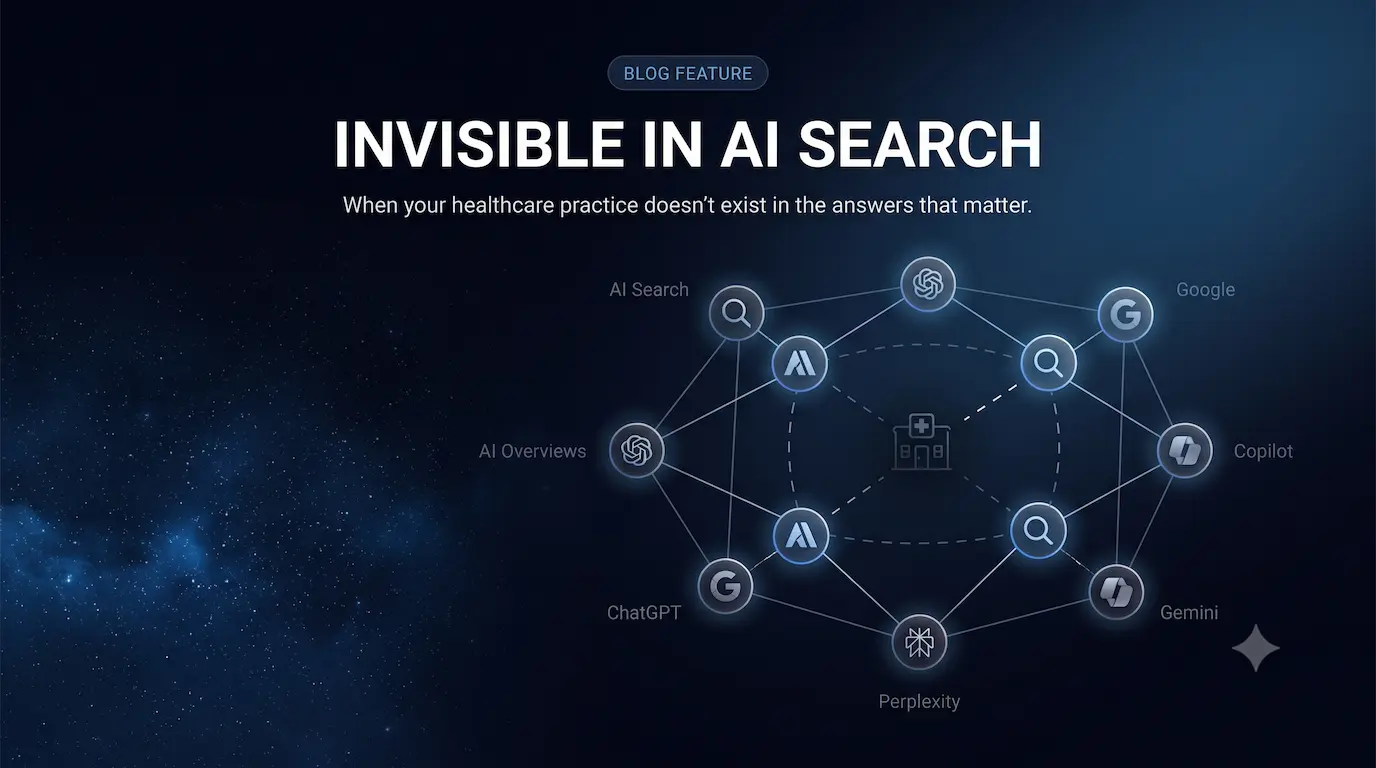

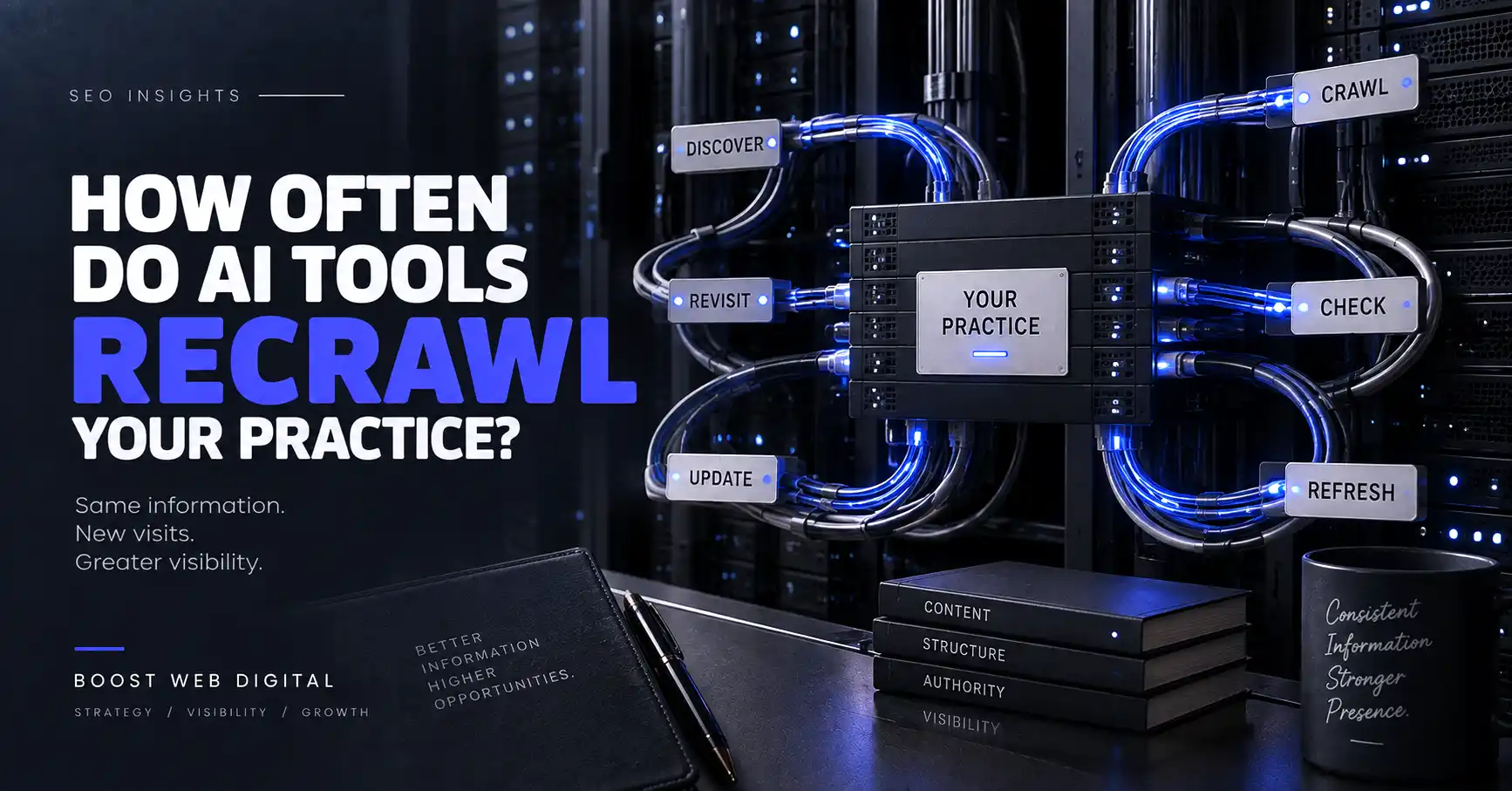
You updated your hours, or you finally cleared a bad review with a good one. Now you want to know when ChatGPT or Google’s AI will actually show the new version. The honest answer is that there’s no fixed schedule. No AI company publishes a recrawl interval, and none of the ones we checked directly even hint at one. Worse, for the exact updates you probably care about most — hours, reviews, ratings — your website may not even be the source AI is reading from.
There Is No Official Recrawl Schedule
We checked the actual documentation from OpenAI, Anthropic, and Perplexity directly. None of them state a fixed interval for revisiting a website. Google’s own guidance says crawling frequency can range “from several days to several months,” decided by its own systems, not by a public schedule.
This isn’t an oversight. These systems crawl based on a site’s size, authority, and how often it changes. A small practice website with a handful of pages simply doesn’t get the attention a hospital system’s site does.
A few specifics are worth knowing anyway. OpenAI’s own documentation says a robots.txt change takes about 24 hours to be reflected in how its bots behave. That’s the one concrete timeframe any of the three major AI companies actually publish. Even that is about permission, not about content freshness — it tells you when a blocking rule takes effect, not when your content gets read.
Anthropic says it’s deliberately careful about how quickly it re-crawls the same domain. It also honors a non-standard “crawl-delay” instruction if you set one on your own site. None of this adds up to a public schedule. It adds up to a set of behaviors you can influence a little, and predict only loosely.
There is no secret number to wait for. Asking “how many days” is the wrong question.
Any blog post that gives you a precise number — “GPTBot revisits every 2.4 days” — is quoting an unofficial estimate from someone’s server logs. It isn’t a published policy. Treat those numbers as one data point, not a rule.
This matters practically. If you’re refreshing your browser every morning hoping to catch the exact moment an update lands, you’re chasing a number nobody can give you. That energy is better spent somewhere it actually pays off, which is the point of the rest of this post.
Three Different Mechanisms, Not One
The real confusion is that “AI crawling your site” isn’t one thing. It’s at least three separate processes, and they behave completely differently.
| Mechanism | Example bots | What it does | Typical timeline |
|---|---|---|---|
| Training crawl | GPTBot, ClaudeBot | Feeds a future model’s training data | Slow, unscheduled, may never revisit a specific page |
| Search-index crawl | OAI-SearchBot, PerplexityBot, Googlebot | Powers real-time citations and answers | Behaves like ordinary SEO crawling |
| Live retrieval | ChatGPT browsing, Perplexity-User, Copilot | Fetches the page the moment a user asks | Instant, but only happens on demand |
A training crawl might never touch your updated page again this year. A search-index crawl responds to normal SEO signals, like a sitemap or a fast server. Live retrieval only fires when someone’s actual question triggers it.
Most of the anxiety about “did AI see my update” is really about the second mechanism, not the first or third.
Each of these bots can be controlled separately through your robots.txt file. Allowing one doesn’t mean you’ve allowed all three. This is worth checking directly.
Some sites got built to block “AI bots” broadly, as a blanket privacy or bandwidth decision. That blanket rule often blocks the search-index crawler too, not just the training one. If you want your practice to appear in AI-generated answers, that specific crawler needs to be allowed in, even if you’d rather keep the training crawler out.