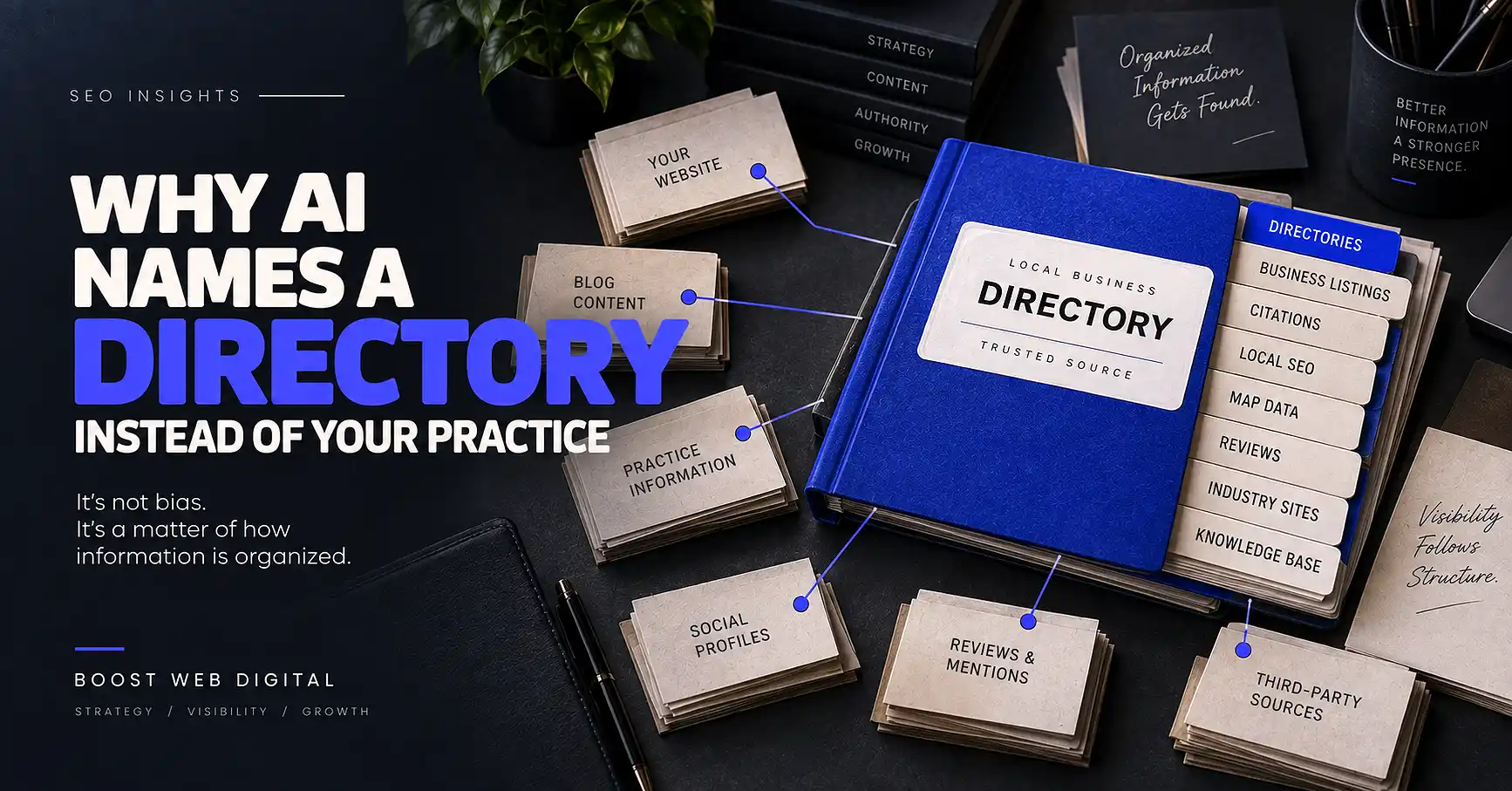
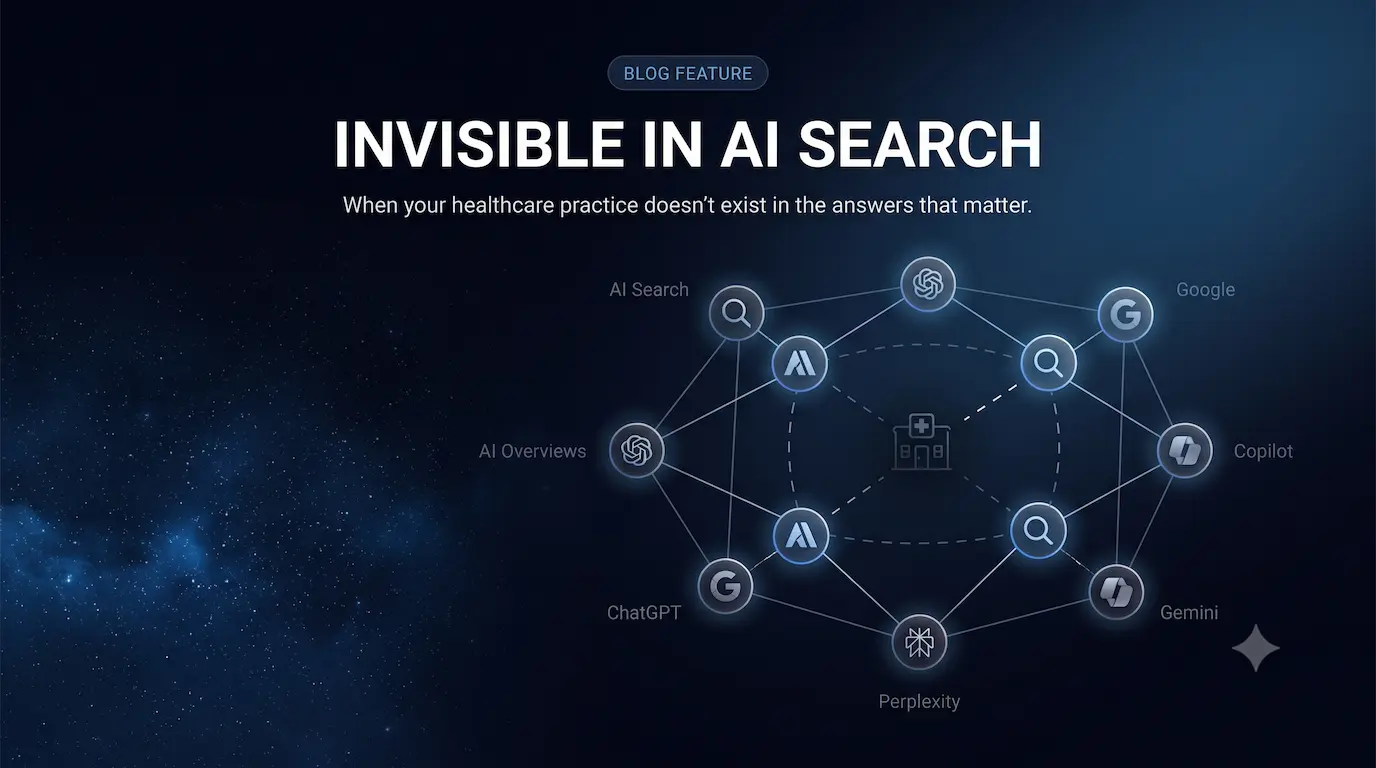
Ask an AI answer engine about your own practice by name. Often, a Healthgrades or Zocdoc profile answers instead of your website. This isn’t a content problem. You can’t write your way out of it.
Boost Web DigitalContributor
··7 min read
Ask an AI answer engine about your own practice by name. Often, a Healthgrades or Zocdoc profile answers instead of your website. This isn’t a content problem. You can’t write your way out of it.
It happens because your website is a first-party source. That means it’s you, talking about yourself. The ranking systems behind most AI answers are built to trust independent, third-party corroboration over self-description. A directory profile isn’t better content than your site. It’s a different kind of source, built specifically to supply a signal your own site cannot.
Your Website Can’t Vouch For Itself
Google has said its AI-generated search features are “rooted in our core Search ranking and quality systems.” They aren’t a separate model with different rules. Those core systems carry a long-standing instruction for the human evaluators who help train them: check a business’s reputation against independent, outside sources. Don’t just take the business’s own word for it.
When a site’s self-description conflicts with what independent sources say, the independent sources win. This principle predates AI search by years. AI search inherited it.
Think about how you’d check out a new practice yourself. You wouldn’t just read their homepage and stop there. You’d check reviews. You’d see if a hospital lists them. You’d ask someone you trust. An AI answer engine is doing a rougher, faster version of the same thing. It just does it for every query, at once, without telling you.
A practice’s own website is the wrong kind of source to answer “is this practice trustworthy.” No amount of polish changes what kind of source it is.
A directory profile is built the other way around. Sites like Healthgrades and Zocdoc pull patient reviews, license records, and hospital affiliations from outside the practice. That’s exactly the independent corroboration these systems are built to reward. Your own homepage cannot supply that, no matter how well it’s written.
What a Directory Offers That Your Site Doesn’t
A patient’s real question usually isn’t “what does this practice say about itself.” It’s closer to “can I trust this practice.” That needs a different kind of evidence.
What’s being asked
Your website supplies
A directory profile supplies
Is this a real, licensed provider?
A claim
A verified license record
What do other patients think?
Curated testimonials, if any
Aggregated, unfiltered reviews
Is this information current?
Whatever you last updated
Continuously refreshed listings
Who else recognizes this practice?
Nothing, by definition
Hospital affiliations, insurance networks
None of this means your website doesn’t matter. It means your website answers a different question than the one these systems are actually trying to resolve.
Directories aren’t the only independent source that counts. So do:
Hospital system directories and referral networks
Insurance-plan provider listings
Professional association or licensing board directories
Local press coverage and named mentions on other organizations’ sites
Patient reviews on any third-party platform, not just your own
Each one is a place someone besides you vouches for you. That’s the actual currency here, not page count or word count on your own site.
You don’t need to be listed everywhere. You need to be listed accurately in the places your patients and their referral sources already check. A hospital-affiliated specialist gains more from a clean hospital directory entry than from ten low-quality listing sites. A cash-pay cosmetic practice gains more from consistent, current reviews than from a professional directory nobody in that specialty actually uses.
Research from the Medical Group Management Association tested close to 5,000 prompts against ChatGPT. The sample covered 200 independent practices across 18 specialties. Zero of those 200 practices got named for generic discovery queries like “best dentist near me.”
The same research found something else worth naming directly. Different query types draw from different source pools. A symptom question tends to pull hospital sites and reference sources. A “best provider” question tends to pull directories and curated lists.
Picture two practices, both dermatology, both a few blocks apart. One keeps its directory listings current and consistent. The other hasn’t touched them in three years. Both have equally good websites. Only one of them is likely to get named when a patient asks an AI tool who to call. The website was never the difference.
We’re telling you what we’ve observed, not what any vendor has confirmed: a well-built, accurate website still gets passed over here. That’s not because the content is bad. It’s because the system isn’t evaluating whether your content is good. It’s evaluating whether anyone besides you has said so.
The fix isn’t a better homepage. It’s more places besides your homepage saying the same true things about you.
This shows up more in some specialties than others. Dental practices feel it especially directly. By Zocdoc’s own account, it markets dentist acquisition as a category and describes dental as one of its most-booked specialties. That’s a self-reported claim about its own platform, not an independent finding. It’s still a reasonable signal that this pattern is mature in dental search specifically.
What Actually Changes This
Getting named starts with getting corroborated. It doesn’t start with rewriting your site again. That means the same core facts about your practice need to appear consistently everywhere:
Your practice name, spelled and formatted the same way every time
Your specialties, described the same way every time
Your credentials and affiliations, current and accurate
Your address and phone number, matching exactly across every listing
Consistency matters as much as presence. A practice listed under three slightly different names across five directories is harder for any system to confidently connect back to one entity. Small mismatches — a suite number here, an abbreviation there — quietly break the connection.
Here’s the plain version of why that happens. These systems don’t know your practice the way a person does. They match records by comparing text. “Smith Family Dental” and “Smith Family Dental, PLLC” might read as two different practices to a matching system, even though any patient would know they’re the same place. Every mismatch adds friction to a process that’s already working with incomplete information.
Independent corroboration is the primary signal these systems are built to look for, not an optional add-on.
This is the specific problem AI visibility and GEO work is built to solve. It means making sure the same accurate facts about your practice show up consistently everywhere an evaluation system might check. Not just on the page you control.
What This Doesn’t Mean
This isn’t an argument for abandoning your website. It’s also not an argument for handing your reputation entirely to Healthgrades. Your site still needs to say the same things, accurately and specifically, that your other listings say.
Your website just isn’t the only place those claims get checked. For many of these systems, it isn’t even the primary place.
Treat directory and listing accuracy as part of the same project as your website. Don’t treat it as an afterthought. A practice that gets both right shows up consistently everywhere a patient or an AI system might look. A practice that only maintains its own site is optimizing for a signal these systems barely weigh.
Start by checking what’s actually true today. Pull up your practice on three or four major directories. Compare the name, address, and specialty list against your own site. Small mismatches are common, and they’re usually the first thing worth fixing.
This doesn’t need to be a large project to be worth doing. An hour spent comparing five listings against your own site will usually turn up at least one real mismatch. Fixing that mismatch costs nothing but time, and it’s the kind of fix that compounds — once your information agrees everywhere, it stays agreeing until something actually changes.
If you want to see this directly, run your own practice name through our free AI Visibility Checker. It sends real patient questions to a live AI answer engine and shows you the exact answer it gives back. That includes which source it actually named instead of you, if it didn’t name you at all.
Written by
Boost Web Digital
Contributor
Find out what AI says about your practice
We run fifteen patient questions across four AI engines, count how many times your practice gets named, and send you the report.