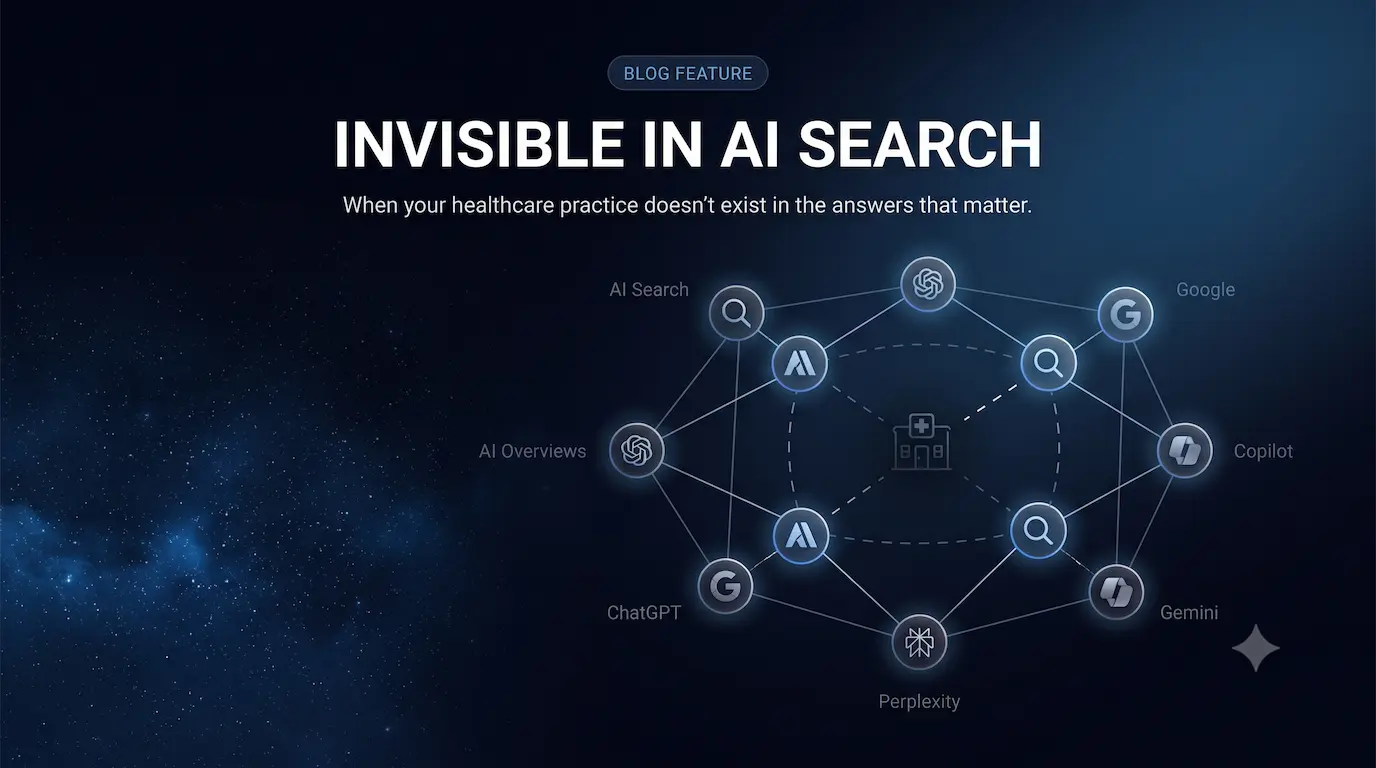
Why “Ranking” and “Being Named” Are Different Games
A dermatology practice we looked at recently holds the #1 organic spot on Google for its city’s highest-volume search term.
Ask ChatGPT, Perplexity, or Google’s own AI Overview the same question a patient would actually type, and that practice never comes up. Three different competitors do — none of them ranked above position four.
That gap is not a fluke, and it is not a temporary bug in how AI systems work. It is the predictable result of optimizing for one system while a second, differently wired system quietly became the one patients actually read.
The Blue Link vs. the Answer
A ranking is a position in a list. The user still has to click, read, and decide.
An AI answer is a decision already partially made — the system has already read several sources, synthesized them, and handed the patient a short list of names it judged trustworthy enough to say out loud.
Being third in that list beats being first in the one nobody reads anymore.
What AI Systems Actually Read
Traditional SEO rewards a well-structured page, solid backlinks, and keyword relevance on your own domain.
AI systems weight something else more heavily: whether your practice’s identity — name, location, specialty, credentials — reads identically everywhere it appears, and whether independent third parties such as review sites, directories, press, and other patients describe you consistently.
Your website is one input among many, not the whole picture.
88%
of health searches now open with an AI-generated answer, up from 72% a year earlier — the blue links sit below it, and increasingly below the fold entirely.
That’s not a niche behavior. It’s the default.
A practice’s entire digital marketing plan can be built around a results page that most searching patients no longer scroll down to.
Why Your Rankings Don’t Automatically Transfer
The instinct is to assume good SEO is good GEO by another name.
Some of the underlying work overlaps — site speed, clear content, real expertise — but the scoring is different enough that a page can succeed at one and fail at the other.
Entity Consistency Beats Keyword Density
AI systems build an internal model of “who you are” from every mention of your practice across the web.
If your Google Business Profile lists one name, your website another, and a directory a third slightly different variant, the system doesn’t average them — it hesitates, and hesitant entities get left out of a confident answer.
Keyword-optimized copy on your own site does nothing to fix a mismatch that lives somewhere else entirely.
Third-Party Validation Carries More Weight
Your own marketing copy describing your practice as trusted, experienced, or leading carries close to zero weight — anyone can write that about themselves.
What AI systems actually cite is what other sources say about you: review content, directory listings, local press, and patient-generated mentions.
This is the same shift that happened to SEO with backlinks a decade ago, compressed into a much shorter window and applied to language instead of links.
The most technically perfect website in your city can lose to a mediocre one with a cleaner, more consistent footprint everywhere else.
The Reputation Gate Patients Won’t Cross
Even a practice that does get surfaced by an AI system still has to clear a second filter before it turns into a booking.
75%
of patients say they won’t book a provider rated below 4.0 stars — reputation isn’t a nice-to-have signal anymore, it’s a hard gate.
AI answers frequently surface the star rating alongside a recommendation, which means a practice with excellent clinical outcomes but a thin, dated review profile can be named by the AI and still lose the patient in the same breath.
Visibility and reputation now function as one combined system, not two separate marketing line items.
Not Sure Where Your Reviews Stand?
We’ll check your current rating and review velocity against the 4.0 threshold patients actually use, and tell you exactly what’s costing you bookings.
Check My Review Profile →
Where Patients Actually Start the Search Now
The shift isn’t only about how the search engine responds — it’s about which tool the patient opens first.
36%
of patients now use an AI tool to find a provider, ahead of Google search at 34% and physician referrals at 32%.
The AI-First Patient Journey
For more than a third of prospective patients, your website’s search ranking is now a secondary signal at best.
The AI conversation is the first touchpoint, and if your practice doesn’t come up in it, your ranking never gets the chance to matter.
This is the practical reason GEO isn’t an optional add-on to a marketing plan built around traditional SEO — for over a third of the audience, it’s the primary channel.
Entity Consistency Across the Web
[Insert Image: /images/blog/entity-consistency-diagram.svg]
Image Alt: Diagram showing a practice’s name, address, and specialty needing to match consistently across Google Business Profile, its website, review sites, health directories, social profiles, and press mentions.
AI systems build their model of a practice from every one of these sources at once — not from your website alone.
Closing the Visibility Gap
None of this requires abandoning SEO.
It requires treating entity consistency and third-party proof as their own workstream, not an afterthought bolted onto a keyword strategy.
Fix Your Entity Data Everywhere It Appears
Audit every place your practice’s name, address, phone number, and specialty appear online, and make them identical, character for character.
This includes:
- Google Business Profile
- Your website footer
- Schema markup
- Directory listings
- Social profiles
- Healthcare directories
- Review platforms
Inconsistency anywhere in that list is a real cost, not a cosmetic issue.
Build the Third-Party Signals AI Actually Cites
A steady flow of recent, detailed reviews, accurate directory listings, and mentions from sources you don’t control are what AI systems treat as evidence.
This is slower to build than a website redesign, and it compounds — every consistent, recent mention makes the next one easier for an AI system to trust.
Key Takeaway:
The practices that show up in AI answers six months from now are the ones building this evidence today. There is no shortcut that skips the consistency work — an AI system that can’t confirm who you are simply won’t recommend you, no matter how strong your website looks.
The practices still optimizing purely for the blue links are solving last decade’s problem well.
The ones building a consistent, well-evidenced identity across the entire web are the ones an AI system can confidently say out loud — and that’s the sentence that actually gets a patient to call.
Find Out What AI Says About Your Practice
We run fifteen patient questions across four AI engines, count how many times your practice gets named, and send you the report — no call required.